
Field Trip Season at Harvard Forest

Photos Courtesy of Academy Hill Teacher, Carol Rosenthal
My Favorite Time of Year at Harvard Forest
This is the time of year that I get to do what most folks think I do year-round; Go outside with kids!
Yes, I do get paid to go outside and share my love of the Forest at its most flamboyant stage- Fall Foliage season. It is, of course the brilliant colors of the fall foliage they are seeking most; Along with access to our renowned artistic masterpieces, the Dioramas in the Fisher Museum. I just get to be the one to guide them through it all, and I'm more than happy to go along for the ride!
Some of the groups that come to Harvard Forest also come to meet their Schoolyard Ecology Project Ecologist. In the fall, some of our young Buds, Leaves, and Global Warming citizen scientists come to meet the scientist who leads this study at Harvard Forest: Dr. John O'Keefe. Those students combine a visit with Dr. O'Keefe with studying the famous dioramas and the glory of the fall foliage outside. Dr. David Orwig, who leads the Woolly Bully; Hemlock Woolly Adelgid study also meets with groups participating in that study at other times of the year.
Academy Hill School (4th Grade)
The photos above are of fourth and fifth grade Academy Hill School students. Academy Hill School has actively participated in the Buds, Leaves and Global Warming study for 6 years, under the dedicated leadership of teacher, Carol Rosenthal. Teacher Sharon Desjarlais has been participating in this study at the Springfield based school, and bringing her students to Harvard Forest for the past 2 years. Academy Hill students collect and share data from the field site at their school with Harvard Forest and have come annually to meet project Ecologist, Dr. John O'Keefe to listen to his 26 years of experience studying leaf color change and the length of the growing season. Students see Dr. O'Keefe interpret a series of graphs of his data and have an opportunity to ask him questions about the science of Phenology and his personal experiences leading up to his career.
Students also participated in arranging landscape photos to tell a story of landscape change before viewing the dioramas.
After exploring the dioramas, students went outside to the Sanderson Farm Trail.


-
Liked when Dr. O’Keefe talked about how things are changing and showed us his
charts.
-
Nature walk- so many trees, looked at different things like pine cones and
mushrooms
 -Playing
in leaves
-Playing
in leaves
-We
got to do things, not just look at pictures of things
-Graph
showing animal population rising and falling along with forestation
-White
pine tree
I
always find that the kids are more motivated for the tree study after we do our
trip. Thanks again for a great day.
Belchertown High School
Many Middle School and High School groups also visit Harvard Forest. Belchertown High School students also participate in the Buds, Leaves and Global Warming Schoolyard Ecology study. Teacher, Louise Levy has participated in the study for 9 years, and is in her 3rd year of leading the Our Changing Forests study there. These high schoolers also meet with Dr. O'Keefe, view the dioramas and head outside for a nature walk on the Sanderson Farm trail. This year they had a special treat included in their tour-they were able to meet visiting artist, David Buckley Borden in his temporary studio at Harvard Forest. David is a bullard fellow who is interpreting the science that happens here through the visual arts. Teacher, Louise Levy shared with me the following response from her class:


We had a really interesting conversation on the bus about
turning some ecological ideas on the BHS campus into works of sign-art, ala
David (Artist,David Buckley Borden). Moira, my Education Major/Art Minor chaperone was very inspired,
and planned on telling "everybody who I can stop and get to listen to
me" on her campus. The students also agreed that we should get the
art classes involved. ... In a word, Inspiring!!


Pamela, Greta, David, John,
Thank you so much for hosting the group. There is
something transformative about the experience that helps my students see that
the leaf-tracking is not just some crazy, meaningless thing another teacher
came up with, but that their data is contributing to our understanding of our
world, if just one small leaf at a time!
2 Change ___
- Include, that we didn’t this year ___
What Dr. O’Keefe, Pamela, Greta
and/or David should know/do
Here is what Belchertown Students said:
If I was running next years’ HF ft, I would …
Keep ___ the same
· All of it
· The weather … we like 75
· Lunch outside
· Art guy
· MsLevy handed us the questions to ask
Dr. O’Keefe (even if they were ours to start with)
· Scavenger hunt
· The dioramas were amazing … how could
the artists do so much with just wire, clay and paint?!!
2 Change ___
· Go by mid-October, don’t miss the
peak of the color
· Stick to the timing on the itinerary
… but we loved the Art guy!
· Get more students to come
· Longer time with the Art guy
· Tag a tree and adopt it, check every
year
- Include, that we didn’t this year ___
· Koziol (another BHS Science teacher)
· Scavenger hunt
· Go upstairs, include the Hurricane of
‘38
· Add cows, keep turkeys, add horses ( I think they mean in Dioramas?)
· What can a “normal” human being do to
get a job that gets you outside that much?
What Dr. O’Keefe, Pamela, Greta
and/or David should know/do
· Come on walk … Dr.O!
· We appreciate that Pamela was so calm
and knowledgeable … it all made sense
· The guys all want to grow a beard
like John’s … some of the girls do, too
· Greta knows so much! We appreciate that she really listens and
answers our questions. We learned so much that Ms. Keefe (BHS school nurse) got
excited and started answering all of the questions in our group.
· David, the kids have already decided
we have to get Ms. St. Pierre (Art teacher who specializes in graphic arts) to
help us do an art installation around BHS
· Moira wants to be an Intern next
summer
Applewild School (Middle School)
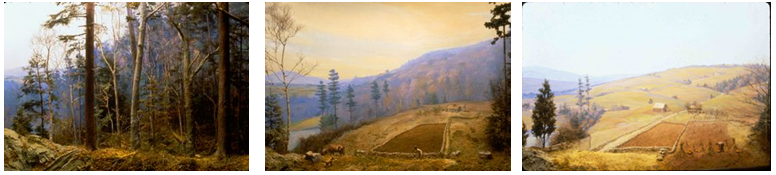
This is the first year that the Applewild School has joined the Our Changing Forests Schoolyard Ecology project and the first year that teacher, Emily Chamas, has brought her class to Harvard Forest for a field trip. Emily wanted her students to get some background in the history of Land Use Change, being that that is the main theme of the Our Changing Forest study and an important part of her class curriculum. Of course that meant exploring the Landscape History of Central New England
Diorama series and related Wildlife graph.
She also asked that we take her students to see an Eddy Flux tower in order for her students to see how the concept of the Carbon Cycle is being incorporated into current ecological studies at Harvard Forest. We also looked at the "Megaplot" Forest Geo field site that monitors a 35 hectare plot as part of a major international study, and saw crazy things like laundry baskets all over the forest floor collecting leaf litter, and space age contraptions on the ground monitoring soil respiration.


We were pleased to hear that students were inspired by all of this to get back out to their own study site with gusto...here is what teacher, Emily Chamas wrote after their visit:
Thank you so much, Pamela!
I wanted to reiterate how much the students (and myself and
Mrs. Lent) enjoyed the trip today. They were abuzz with excitement upon
arriving back at school and are excited to get back out in the woods here
tomorrow!
Other Schools
Some schools that do not participate in the HF Schoolyard Ecology program visit Harvard Forest to provide a window into the world of Ecology. We very much enjoyed hosting groups from the Village School (Elementary) in Royalston. Pathfinder Regional Vocational Technical High School ;Montachusett Regional Vocational Technical School; Leominster High School; and The Bement School (6th Grade, Deerfield).
Fisher Museum Closes November 1st
The Fisher Museum that holds these dioramas is getting ready for big facelift. The museum will be closed for renovations between November 1st and April 1st. At that time, any visiting groups will not have access to the dioramas. We are only accepting tours for that time period that are either all outside or have groups of less than 20 students who can fit in our seminar room to meet with a Project Ecologist. Groups who would like to combine a viewing of the dioramas with their visit, can book ahead for Spring.
Related Links:

Leaf color change and Growing Season Phenology Studies
Forest-atmosphere-exchange Towers
HF Forest-Soil-Respiration-22-year-analysis

Bullard Fellow: Artist, David Buckley Borden
twitter:
@dbuckleyborden
instagram:
@davidbuckleyborden
Harvard Forest Field Trip and Fisher Museum Information
HF-LTER Schoolyard Ecology

Harvard Forest Schoolyard Ecology is Seeking Financial Support for Field Trips
Please contact Pamela Snow at psnow@fas.harvard.edu to discuss ways of paying for field trip scholarships to cover the costs of transportation and staffing of field trips for groups that cannot afford to come at present. While we currently we have no funding specifically allocated for field trip support, we are able to reduce fees upon request of visiting groups. We welcome any help in supporting groups that do not have the capacity to pay for field trips.


