Thursday, June 16, 2016

Schoolyard Ecology Teacher, Lise Letellier, Presidential Award for Excellence in Science Teaching Finalist Award


Journalist Josh Binswanger introduced  The Massachusetts Finalists for the 2015 Presidential Awards for Excellence in Mathematics and Science Teaching at a Celebration in Honoring Excellence in Teaching at the State House on June 15, 2016.


Massachusetts Commissioner of Elementary and Secondary Education Mitchell D. Chester presented the PAEMST Finalist award to Holyoke Catholic High School Teacher, Lise Letellier.


Lise Letellier has been featured on this blog several times for her contributions to the Buds, Leaves and Global Warming Schoolyard Ecology project.   Her presentation about her 5 year journey with this project was featured this spring on the following entry:


In addition to having mentored many new Schoolyard Eco teachers and contributing  numerous teaching resources she developed on the Harvard Forest Website, some of her Phenology curriculum is published on the LTER Education Digital Library.  Lise  and her students have also contributed to the Woolly Bully and the Hemlock Trees project.

Aside from her work with Harvard Forest, Lise has also served as a mentor and leader for the Appalachian Mountain Club, engaging both teachers and students in outdoor investigations. This work has been highlighted in a national  Project Learning Tree newsletter.

Lise's contributions to STEM education extend beyond leading field projects.  She has led the science department at her school for several years, and is the chair of the K-12 STEM Professional Development Steering Committee for the Springfield Diocese, and has served in the past on the Pioneer Valley STEM Executive Committee as well as the the review committee for the Mass. STEM Summit. 

Please join me in congratulating Lise for her EXTRAORDINARY contributions to science teaching!

We wish you every success in being honored at the National level....Final awardees are expected to be chosen later this summer.


Friday, June 10, 2016

Petersham Center School Student Wins Statewide Arbor Day Poster Contest!

Fifth grader, Lillian Maxwell's  Arbor Day poster from the Petersham Center School won the state-wide DCR competition this year.  


Massachusetts Department of Conservation and Recreation (DCR)  hosted an awards ceremony and tree planting session at the Petersham Center School yesterday, led by Urban and Community Forester Julie Coop.


 A number of 5th graders from throughout the state were also honored with Honorable Mention Awards.  This year's theme was "Trees Grow With Us and For Us".  Each of the winning posters approached showing how trees benefit us in very different and effective ways.


 Two Petersham students shared  Tree Poems at the Ceremony


  It was the Petersham Center School's first year participating in the contest.  Harvard Forest Education and Outreach director, Clarisse Hart approached 5th grade teacher, Melissa Fournier, with the idea of participating in the contest.  Melissa enthusiastically took on the idea, and arranged for the Petersham Tree Committee and Harvard Forest to work with students in learning about "ecosystem services" that trees provide.  Sheila Youd of the Petersham Tree Committee even led a tree drawing lesson for the students.

5th Grade Teacher, Melissa Fournier
Reads "The Giving Tree"


Petersham Center School Principal, Joanne Menard speaks to
audience about the importance of Trees in Petersham


The Arbor Day  Ceremony ended with a Popsicle Party

Tuesday, May 17, 2016


Woolly Bully and the Hemlock Trees Project Ecologist David Orwig has been all over the news recently.  


David Orwig and Gary Lovett, a scientist from the Cary Institute contributed to new paper dealing with invasive pests and pathogens that was released by  the Science & Policy Exchange recently.  This paper has been getting tremendous media attention.

The following update was put together by Clarisse Hart :

Tuesday, May 10, 2016
Printer-friendly version
Imported forest pests cause more than $2 billion in damage each year and can be found in all 50 U.S. states. Efforts to prevent new pests must be strengthened if we are to slow the loss of our nation’s trees, says a new study co-authored by Harvard Forest scientists David Orwig and David Foster. The study was led by the Cary Institute of Ecosystem Studies and coordinated by the Science Policy Exchange, a research consortium based at the Harvard Forest and led by Kathy Fallon Lambert and Marissa Weiss
The study, published today in Ecological Applications, was conducted by a team of 16 scientists - from Harvard Forest, the USDA Forest Service, The Nature Conservancy, Dartmouth College, McGill University, and Michigan State University. It is the most comprehensive synthesis to date on forest pests. It covers both ecological and economic impacts and evaluates a range of policy solutions.
According to the study, 57 imported forest pests live in Massachusetts today. Our region is particularly susceptible to new pests because our forests contain many trees that are closely related to trees in Europe and Asia.
Today, sixty-three percent of U.S. forestland, or 825 million acres, are at risk of increased damage from pests that have already established here. 70% of those forest pests arrived on imported plants. An average of 2 to 3 new pests arrive each year.
Current efforts to prevent new pests are not keeping pace with escalating trade. However, the study reports that current trade policies are projected to return $11 billion in net benefits by 2050. The authors project larger benefits with stronger pest prevention efforts.
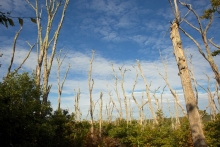
(Photo of dead oaks on Martha's Vineyard, due to invasive winter moth caterpillars, by David Foster.)
 ------------------------------------------------------------------------------------------------------------------------

Listen to this radio interview David Orwig at: 


More articles related to this story:  


Newsweek
http://www.newsweek.com/more-forest-pests-ever-are-entering-us-and-its-costing-public-fortune-458060


WESA – Pittsburgh
http://wesa.fm/post/pa-second-only-ny-number-invasive-forest-pest-species

E&E News Greenwire
http://www.eenews.net/greenwire/2016/05/10/stories/1060036983


Twitter Highlights: 

From @postgreen:
https://twitter.com/postgreen/status/730068597897363458  


From @USLTER
https://twitter.com/USLTER/status/730083988438548480 


For more information on the Woolly Bully and the Hemlock Trees Schoolyard Ecology study for students in grades 4-12, go to:


Teachers can register to participate in a workshop to learn how to lead the Woolly Bully citizen science study in their schools at:


Wednesday, May 4, 2016

Profile of Excellence in Environmental Education

What does Excellence Look Like? 


Francis Parker Charter School Teacher, Judy Gibson was recognized at the Massachusetts State House this week for Excellence in Environmental Education. 


Judy Gibson is not the kind of person who draws attention to herself in the usual ways. She comes off as quiet and reserved.  She may appear to be sitting back, as she lets others take center stage. Throughout it all, she is carefully observing, listening and researching.  She then takes the information and opportunities she has gathered up, and works step by step at crafting meaningful experiences for her students.  Judy’s students are given the foundation from which they can become citizens who care about our earth and water; Citizens who know about our earth and water from direct experiences in their Middle School years, thanks to one teacher’s thoughtful approach to education.  This is the kind of experience I hope all students can receive in order to best prepare them to make wise choices about our natural resources as they mature into responsible citizens.


Judy has dedicated many years to providing Middle School students opportunities to delve deeply in exploring, researching and touching aquatic and terrestrial natural systems within reach of their school.  Judy is a key part of the middle school science team at Parker. She is one of three teachers, who do a great deal of collaboration in designing the natural science units.  Judy has engaged students in field research projects in their local environment, beginning with vernal pools in walking distance from their school, for well over 7 years.  In 2009, Judy added to the work she set up for her students to include a scientific protocol looking at hydrology of vernal pools in cooperation with  Harvard Forest Ecologist, Betsy Colburn. Judy not only succeeded in getting students to collect pool diameters, and depths, etc. at her own school, but she became a mentor for teachers at a network of other schools involved in this work as well.  Judy regularly presented the innovative curriculum and learning methods she developed at the Parker Charter School with teachers from a wide range of schools at teacher workshops, so that more students could benefit from this work.


Who Eats Who? 

In 2013, Judy led a group of teachers from the Parker Charter School in taking on an investigation of forest dynamics as a team.  She and her 2 colleagues teamed up with more ecologists at Harvard Forest. They led their students in setting up and monitoring a series of forested study plots in their schoolyards.  Their students have collected tree species and diameter data, observed sign of wildlife, invasive species and pests, and many other field site characteristics as part of this study in the past 3 years.  In contributing to this study Judy and her colleagues provide data that can be compared region wide to tell a story of land use change over time.  With this combined information, we can begin to get a better picture of how forests are changing throughout New England.


 Judy’s efforts have led to 20-150 students each year participating in authentic environmental field studies, as well as the broader reach of presenting and sharing materials and data with a network of over 100 teachers.  These students are getting the opportunity to be real scientists and to connect and learn about the water and earth around them.  Judy takes the extra time and effort needed to organize and manage working outdoors both during the school day and in after school group.  It is this kind of in depth dedicated work over the long term that makes Judy’s work stand out.  I am thrilled that she has been honored by the Massachusetts Executive Office of Energy and the Environment for her outstanding work.


To learn more, go to the following links:


See Powerpoint slide presentations that Judy Gibson has shared with Schoolyard Ecology teachers: 


2015.Life in a Wicked Big Puddle-VP.pdf

2015.Starting The Our Changing Forests Projects-Year 1.pdf

.2014.Shepley Hill Vernal Pool.pdf


Find the Parker Charter School location on our interactive map and explore project data:

google.com.Schoolyard maps


More about the Our Changing Forests project:

http://harvardforest.fas.harvard.edu/Our_Changing_Forests


More about the Vernal Pool project:

http://harvardforest.fas.harvard.edu/water-landscape-vernal-pools


More about the Excellence in Environmental Education Awards:


Tuesday, April 26, 2016

Trees are Greening Up as I write this....


Take a look outside in most of  our region and you will see that the trees are beginning to leaf out...one by one....


You know what that means, Buds, Leaves and Global Warming Teachers!

If you haven't already, get your students outside as soon as possible to track leaf emergence on your study trees.


We are excitedly collecting spring data on our trees. We had a surprise last week, pictured in these attachments. A beaver felled the crab apple tree #18. The study leaves were out so the team measured them and recorded on the data sheet but I guess this will be the last year for that tree! We have not seen the beaver but the tree was standing the week before. 


Photo and comments from Jane Lucia, Williston Northampton School 


Here is what the Phenocams are showing:


From the Northeast (Reading, Ma.)


What phenological changes can you see on any of these trees between
March 8th and April 26th?


Southwestern Massachusetts (Springfield)


Mid Atlantic Region (25 miles from Washington DC): 


North Carolina:


What are things looking like near your school???


Please send us photos and notes from your field site and/or school location so we can better see where buds are bursting and leaves are emerging.


Email photos and comments to Pamela Snow at psnow@fas.harvard.edu


To search for canopy images from throughout North America: 

Go to the Phenocam website at:https://phenocam.sr.unh.edu/webcam


For more about tracking Budburst through The Harvard Forest Schoolyard Ecology program:


Tuesday, April 19, 2016

Teachers Steal the Show at Spring Workshop

Schoolyard Ecology Teachers Took Center Stage at Our Spring Workshop for Teachers on March 31st at Harvard Forest


Beginning with introductions, teachers had so much to contribute and update on...we ran over well over the time I had allocated in the agenda.  I could have cut folks off sooner, but it was clear that the entire learning community of classroom teachers, environmental educators and scientists was all ears to hear what each teacher had to share.

Hemlock and Buds groups each met in breakout groups before heading outside.


Into the Woods

Teachers actively contributed to field discussions as well.  Scientists allowed the teachers to lead the focus of the discussion with their many questions and comments about field protocols, seasonal changes, physiology, etc.


Teacher Presentations


The afternoon was highlighted  by teachers and naturalists formally presenting the way they are engaging children in field ecology projects.


J.R. Briggs Elementary teacher, Katherine Bennett, and Austin Preparatory School teacher, Maria Blewitt each shared the ways they are deepening students' understanding of the science of Phenology.  Both teachers have contributed to the Buds, Leaves and Global Warming study over several years. Both also host web cameras called "Phenocams" on the roofs of their schools to track the greenup and green down of the tree canopy near their schools.  Kate shared some of the impressive array of educational resources that she has helped develop for the Project Budburst webpages. 


 Kate shared some of the impressive array of educational resources that
she helped to develop for the Project
BudBurst webpages.

Kate collaborated with Phenocam scientist, Andrew Richardson, along with Project Budburst coordinator, Sandra Henderson and team to develop these in depth, colorful activities and lesson plans that help students to understand the science of Phenology.


Maria Blewitt shared the step by step process she used in graphing the Phenocam data provided by the Phenocam at her school in Reading, Ma.    


Mass Audubon Educators, Sally Farrow and Erin Pitkin, then updated us on how they are helping students of all abilities engage in both the Vernal Pool and Phenology studies at Drumlin Farm and Lowell schools.  Sally showed us a variety of graphs she is sharing with students that tell the story of the hydrology of the vernal pools and ponds at Drumlin farm where over 5,000 students have participated in the the Harvard Forest Schoolyard vernal pool  study over 8 years.


Erin Pitkin, in her first year working with the Schoolyard Vernal Pool and phenology studies, shared a set of visual resources she developed to allow a diverse range of learners to access the scientific protocol.

A number of schools provide student "Eco Monitors" who regularly collect data for Harvard Forest Schoolyard Ecology projects sited at Drumlin Farm in Lincoln, Ma.  Erin showed how she is adapting and creating tools for students of diverse abilities to participate in this work.


Holyoke Catholic High School Teacher, Lise Letellier lead the charge with her impressive and comprehensive telling of her 5 year journey through Schoolyard Ecology.  See my previous blog entry for more on that presentation along with the related links below.


Survey Comments from Workshop Participants: 


  • All of the presentations were well done! I am excited to take the great ideas and implement them into our program.
  • all of the teacher presentations were excellent.
  • teacher talk time was sooo helpful! Great discussion about what else to keep track of since yearly change is not significant enough to graph. So great to learn about phenology and phenocam resources,
  •  All the presentations helpful and presented new information and inspiration which will benefit our programs.
  • Kernals of gold nugget in each and all of them!
  • Lise gives me hope that I, too, can have my students tackle data!
  • The opportunity to meet and speak with the other teachers and hear the presentations gives me hope and inspiration and definitely renews my passion.
  • both the walk and the teacher presentations definitely renewed my passion.  I hope to eventually get to the point where I can contribute to the discussions and presentation.
  • Today's presentations were mostly applicable to all protocol and made new resources accessible and offered ways they can help us teach the standards. 


To see teacher presentation slides and hear audio on Adobe Connect, go to: 


To access PDF documents of teacher presentations, go to:


Bennett,K.Taking Phenology Education to the Next Level.pdf

Blewitt,M.Using the Phenocam Website with Your Students.pdf

Letellier, L. Five Years of Data Presentation.pdf

Farrow,Pitkin. Eco. Monitoring for All Learners.pdf


To access the complete Survey Monkey Spring workshop evaluation, go to:


To follow up on any questions or comments about this Blog post or Harvard Forest Schoolyard Ecology, email:


 Pamela Snow


Or add your comment on this blog below...