Friday, May 29, 2020

We Will Miss You Liz!

As many of you already know, the Harvard Forest Schoolyard Ecology and Long Term Ecological Research (LTER) network communities mourn the tragic loss of Liz Duff, our Education Coordinator and long time colleague who died May 15.
Photo by Mike McCarthy


So many of us have been touched by the work and life of Liz Duff ...We have gathered a few remembrances of Liz from the Harvard Forest Schoolyard Ecology community as well as from the broader  (LTER) community to try to show a broader view of how Liz specifically touched those of us who worked with her in this area of her life.


Liz was a passionate educator and environmentalist.  There was nothing she loved better than being in the field with her students, teaching them about the marsh and how to protect it.  She has been the education coordinator of the PIE LTER since our very beginning and made a tremendous contribution to our program.  She always made sure we did not forget that education was a critical part of our mission.  All of us will miss her greatly. 
Plum Island Ecologist, Anne Giblin


Harvard Forest Schoolyard Ecology Teachers had this to share:


I found these photos of Liz as I was going through some older pictures and wanted to send them to you .... I took them while I was taking the MITS training at the Great Marsh LTER in Summer 2015. They capture her doing what she loved to do best, teaching teachers about conservation biology in the field.

Mike McCarthy,Thurston Middle School, Westwood, MA


An afternoon in the summer of 2018, preparing a lichen lesson with Liz to share with teachers for a Wade Institute class.  Liz was an amazing educator, who shared her passion for making the world a better place with so many teachers and students. I learned so much from her.  

Emilie Cushing, Glen Urquhart School, Beverly, M


Liz and students from O'Maley Innovation Middle School collecting data of transects from the marsh at Eastern Point in Gloucester to understand impacts of sea level rise.

Amy Donnelly and Dan Thomases, O'Maley Innovation Middle School, Gloucester, MA

 Photo by Amy Donnelly


Memories of working with Liz many years back and through HF Schoolyard generate fondness in my heart for her chuckling, easy going, collaborative disposition.

Mit Wanzer, F. W. Parker Charter Essential School


As a Boston Park Ranger, I participated in a Watershed Education workshop that Liz led at Endicott Audubon Wildlife Sanctuary in the 1990s.  I worked most closely with Liz in my current work in LTER Education.  Below is a slide I included in a presentation for educators in 2006, which is just a small indication of the value of Liz's collaboration with Harvard Forest Schoolyard Ecology outreach and education work. 


Liz mentoring new Buds, Leaves and Global Warming project Teachers
Pamela Snow, Harvard Forest Schoolyard Ecology

More comments from LTER Educators:


 I was regularly inspired by the thoughtful and thought-provoking questions she raised in EOC (Education and Outreach Committee)  calls. It was always clear that she loved what she did, inspired and influenced those around her, and was generous in sharing her knowledge. She will be greatly missed.
Caitlin Potter, Cedar Creek, LTER, Minnesota

That breaks my heart! She was such a lovely person and a wonderful educator. We will all miss her, as I know the kids of her program will too.  
 Jill F. Haukos, Konza Prairie Biological Station, Kansas

Blogger Pamela Photo by Liz
I was able to participate in many professional development opportunities both as a leader and participant; teacher conferences; environmental education conferences; Secretaries Advisory Group on Env. Ed. (SAGEE); Wade Institute (formerly MITS)  and LTER Education and All Scientist Meetings alongside Liz through the years.  Liz took the photo of me at left during the All Scientists Meeting in Pacific Grove California...I had taken photos of her on her camera..and so, do not have one to share here ...we were taking some time between meetings here to bask in the magnificent glory of the rainbow by the ocean and whale watching from shore with binoculars at that moment together. This image helps me remember the inspiration we shared through these learning and teaching moments through the years.

Earlier this week, I walked the beach at Plum Island and thought about Liz's love  of the ocean, and sent her warm wishes on her journey, imagining that she is still able to tune into that beauty that she dedicated herself to sharing with others, alongside my late sister, Susan, who worked with Liz through the Gulf of Maine institute and Mass. Coastal Zone Management outreach.

Friends and colleagues are encouraged to post remembrances of Liz on her Facebook page (@Liz Duff) and make donations to environmental education organizations.

 Her obituary, and ways to honor her memory can be found at  https://obituaries.gloucestertimes.com/obituary/elizabeth-duff-
1079218499

Rest in Peace Liz!  Your memory and work lives on in all of us you touched.


Monday, May 4, 2020

Monitoring Buds Burst in the Time of Covid-19


Multiple approaches  to getting students observing the timing of leaf out in the time of school closures.


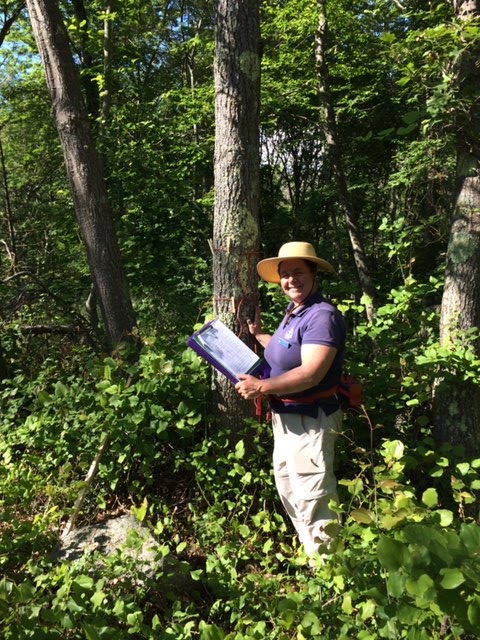
Hanover H.S. Student, Celeste Farrell monitoring Bud Burst at her schoolyard during school closure


From the Northern-most  Field Site, student volunteer based monitoring: 

I am taking data with Celeste's help with the 12 core trees so that we can continue determining the growing season.  She is standing at tree #13 (sugar maple) which is one of the trees that has been in the study the longest and we were practicing social distancing as we marked trees with flags and green twisty ties. I will be uploading data as I collect it.  Only the box elder had puffy buds.  The maples are next!  -Maryann Postans, Hanover High School, New Hampshire


From the Southern-most Field Site teacher led photo sharing approach:


Dr. Elisa Margarita, teacher at Brooklyn Technical School in New York,  has gone out for several visits to her class's field site at Fort Greene Park and taken photos of the buds to share remotely with students. She asks them to reply with the status of the buds based on the Harvard Forest protocol. 


Dr. Margarita is continuing to monitor, photograph and share remotely the bud/leaf out status of each of the study trees with students throughout the spring, until all study leaves have emerged. Stay tuned for her full documentation of bud burst on our website-coming soon.


Teacher, Jane Lucia from the Williston Northampton School, took a mixed approach.  

Remote Photos:   I was able to get over to school today and took some pictures. Though it is after the (HF Schoolyard Zoom Spring Workshop session 2 led by Dr. O'Keefe) workshop, These were taken April 17, 2020 on the Williston Northampton School Campus.


The white paper background was so helpful for focusing and seeing the buds. I also recorded the 6 buds for each tree on data sheets. I will make an effort to get out a few more times to capture leaf out as best as possible. I am also sharing this link with my students for observation, though I only took photos of one of the branches on each tree.

See more detailed teacher resources that Jane has shared for other teachers below!

Jane also incorporated a backyard monitoring assignment based on the recommendation of Dr. O'Keefe as seen in the data sheet below.


Special Backyard Protocol created by Harvard Forest Project Ecologist John O'Keefe for students monitoring trees in their neighborhoods:
See below for link to Remote Buds Data Sheet


Dr. John O'Keefe was the lead presenter at our 2nd Spring Workshop for Teachers Zoom Session.  

Here is what teachers shared about how they are adapting to doing Phenology outreach remotely:

Teacher Comments: 

I especially appreciate the updated/modified data sheets for our kids to explore the Phenology of the trees in their own yard or neighborhood! 

I realized today for the first time that the entire leaf must be showing to be considered leaf fully emerged.  I loved the mystery game and the ideas the teachers had Lucia - sketches and observations . I love the forcing the branch and the at home protocol with trees at students home. I might do versions of each over the next few weeks in addition to sending the kids the photos of their tree branches.

The workshop was very motivating and provided me with a wealth of ideas for my students. 

 I am more ready to take photos of branches using the white paper technique- with the tree names and dates on the papers! With this method, it seems more possible that I could share the photos with the students for observation and determination of the start of the growing season for their tree. 

I always learn from what the teachers are doing and sharing. They are so creative. I may not be able to use the information right away but it will be super helpful for the future 

It will take some time to figure out how to approach this with younger students. We certainly hope to give them a sense of what they would be doing if we were in school. 

I was not sure about how to go about this remotely but I think if I stay simple, it will be best as my students are young

 It clarified some ideas I had about students collecting data remotely. 

Clarification of the size and "puffiness" of buds was helpful; Thanks also for the online resources & guides 


Related Resources


PhenoCam Lesson Plans
The PhenoCam Network tracks seasonal change (Phenology) in biomes across North America using hundreds of web-cameras, with a gallery that can be explored and analyzed online.

Coming This Week: 

Spring Workshop Session 4 is scheduled for Wednesday, May 6th 3-4 p.m.  

Three Schoolyard Teachers will share how they are teaching Ecology remotely, including learning activities related to Phenology, Bud Burst, Tree and Animal ID,  Backyard Biodiversity.... 

To join us for this free webinar, Email Pamela at psnow@fas.harvard.edu   


Tuesday, February 25, 2020

Spring Workshop April 9, 2020 Preview

What to Expect for Spring Workshop 2020


Bud burst Preview with Dr. John O'Keefe


Teachers practice identifying trees and the stages of Bud burst using help of experienced teachers, staff and field guides.

 Field Walks with Project Ecologists


T

Buds, Leaves and Global Warming Group explored the stages of
 Bud burst outdoors as well. 


DRAFT AGENDA 2020:  


Reminder : This workshop is Free of Charge to all active Schoolyard Ecology Teachers


Whole Group Discussions


 Student Work "Poster Session"


 Teacher Presentations


 5 and 10 Year Teacher Achievement Awards


Lightning Rounds Slides from All Teacher Participants


What Teachers Said Last Year:  


Teacher comments about Project Breakout Sessions and Field Walks:

  • Great to be able to see specimens and ask questions about the development of the buds
  • Helpful to see woolly bully to help with my identification. Helpful to walk with other teachers and discuss how they are using these projects to teach
  • Awesome part of the day! There is nothing better than getting out and seeing and hearing things directly--thank you!
  • As a newcomer, I felt like I was able to get some understanding of how to lead students in counting buds, and which buds. I also have the context of the work to share with students.
  • I really liked listening to the other teachers share their stories
  • I learn so much every time I listen to John present - I filled up 2 pages with notes and ideas to bring with me. It's always enlightening to look at branches that are being forced, challenging my ability to identify and notice details
  • John gives a renewed energy for the spring with his experience and expertise
  • The walk with Audrey was fabulous. It was so good to have a chance to listen to Audrey share her knowledge and have a chance to ask questions. 


Comments on Last Year's  Teacher Presentations:  

  • I loved hearing what other teachers are doing--I can't wait to re work some curriculum for next year.
  • Graphing literacy is becoming more and more important on the MCAS, good to have this information
  • Joe's work was something I might be able to scale down for middle school and Mary's was something I might try to scale up.
  • Mary did an amazing presentation! I really appreciate seeing how this project's data is being used to expand understanding at the elementary level. I loved the chance to see all the ways to use this project in student's learning.a of putting together a book for the students to see their work over the course of a school year.


Wednesday, January 29, 2020

How are Teachers Looking at Schoolyard Data?


Schoolyard Ecology Teachers from New York, Connecticut. and Massachusetts returned to Harvard Forest this January to deepen their understanding of project data.  Here is a snapshot of what they worked on...


Brooklyn Technical High School Teacher, Elisa Margarita, chose to adapt the new online graphing tool exercises for use by her students.  Above are some excerpts from what she was able to draft during the data workshop, using her school's Buds, Leaves, and Global Warming project data and the northern most site as found on the field site map and data base. Elisa will also incorporate some of the content from Dr. Betsy Colburn's workshop slides to help students better understand visualizations of project data. 


Greater Lowell Technical School Teacher, Tara Alcorn, worked with Project Ecologist, Dr. David Orwig to create this representation of data collected at Harvard Forest using the Schoolyard Ecology Woolly Bully and the Hemlock Tree protocol.  Using a trend line, Tara is able to show a relationship between the number of egg sacs and the amount of new growth of  Hemlock trees.  Not surprisingly, the more egg sacs, the lower the amount of new growth is found.


Groton-Dunstable High School Teacher, Melanie McCracken, was mentored by Choate-Rosemary Hall Teacher, Joseph Scanio in working with a data visualization software, called  Tableau.  The three figures above were among the data representations they created.  While Melanie was impressed with the potential using this tool, she was disappointed to learn that it is very challenging to access it on Chromebooks, which is the hardware her students use at school.  Another teacher had hoped to participate in the Tableau session but when he found out about the issue with Chromebooks, he moved in to another break out session to work on graphing with Google Sheets.  We are finding most teachers especially in the public schools, relying solely on Google hardware and software.  This, brings up issues of who controls what students have access to in the classroom, that are beyond our control in providing professional development to teachers.  Given that limitation, there is still the possibility that these teachers could: A. Find a workaround to using Tableau on Chromebooks and B.  Develop visualizations like this on their own PCs, etc. in order to use as teaching tools that ask the students to interpret the representations rather than create graphs themselves.


Massachusetts Audubon Educator, Sally Farrow, made progress in graphing her impressive vernal pool data sets from Drumlin Farm and Concord Middle School using Excel, with the help of Dr. Betsy Colburn.  These data representations will serve as teaching tools for the hundreds of students that come to Drumlin Farm each year to participate in data collection there.  Concord Middle School students will have a new tool to better understand patterns of water level changes over time even given years of missing data using the bar graph above.


Connecticut Audubon Educator, Marge Porter, with the help of  Schoolyard Ecology Project Coach, Fiona Jevon, was able to create pie charts showing species composition of both study plots and a a bar graph  of tree diameter by individual trees over 2 years.  Marge is learning how to add data representation to the ways she coaches teachers at nearby schools in Connecticut, in participating in the Our Changing Forests project.


Williston School Teacher, Jane Lucia, was mentored by HF Research Assistant, Joshua Plisinski, and Project Ecologist, John O'Keefe, in developing this series of graphs showing how the timing of leaf drop differs by species at her site over time, using Buds, Leaves and Global Warming data.


Harvard Forest staff and Mentor Teachers supported participants in reaching their data management and representation goals as needed.
 

Ecologist, Dr. Betsy Colburn provided an Introduction for all participating teachers and then teachers broke into self designated breakout groups by experience and focus.


 HF Information Manager, Emery Boose, introduced first year teachers to the process of data input and management, using the online database he designed for HF Schoolyard Ecology.

Links to Explore More:

New This Year:


Snow, P., Boose, E. 2020. Buds-Leaves Online Graphing Exercises.(Draft)
Snow, P., Boose, E. 2020. Hemlock Woolly Bully Online Graphing Exercises.(Draft)
Snow, P., Boose, E. 2020. Changing Forests Online Graphing Exercises. (Draft)

Snow, P. 2020. Teacher Created Graphs 2020.pdf


Updated this Year:

Boose, E. 2020. Intro to HF Schoolyard Data Management. Presentation


Existing Resources Used at This Year's Workshop:


MARK YOUR CALENDARS:

Harvard Forest Spring Symposium; March 17, 2020  including Education panels and discussion
Phenocam Workshop for Teachers:  Northern Arizona University, March 12-14, 2020
Spring Workshop For Teachers:  April 9, 2020
Summer Institute for Teachers :  Tentatively scheduled for Aug.18 and 19, 2020.