|
| Skunk Cabbage by Sally Farrow, Drumlin Farm, Lincoln, MA |
The awareness of early spring struck me almost literally in mid February as was skiing in Quebec through a thunder and lightning storm in pouring rain. This was certainly not what I expected to find after months of preparing for skiing hut to hut through the "normal" below freezing conditions northwest of Montreal in winter. Rain in Quebec was not out of the question, as I had encountered rain in Quebec city in February years ago, but thunder and lightning, really???
Upon my return to New England on February 25th, I was greeted with 60 degree temps, and my Facebook feed and email inbox were reflecting a bunch of unusually early signs of spring.

Earliest snowdrops ever. Sighted in the hilly wilds of West Hawley, MA on 2/25/17!
Edite Cunha
  |
Left: Nature Log. Petersham, MA. Thursday redwing blackbirds arrived. Satureday ice went out on the ponds. Fifteen min. later Canada Goose finds open water. 2-26-16
Tom also reported seeing 2 Eagles nesting by Quabbin Reservoir that week.
Right: Wood frog near the Swift River in Petersham on March 1! Skunks also out tonight....
John Burk.

March 2, amherst ma
Audrey Barker Plotkin
Aside from these casual observations, here are some more scientific reports:

Definitely worth checking out an article and new set of scientifically backed maps produced by the USGS-led USA-National Phenology Network that shows just how unusually early spring is arriving in the United States.
To see some specific examples of phenological changes occuring in Spring in the Northeast, check out:
Back at Harvard Forest, researcher Joshua Rapp is busy collecting and measuring Maple syrup.
This is what he's been finding since Feb. 18th about early spring harvest:

This year I tapped the maples at Harvard Forest on February
18th and collected the first sap on the 19th, near the median day for the
season start day around here. While the season started at the 'normal' time,
the start of the season was anything but normal - 60 and 70 degree temps in the
first week started the sap gushing and in less than 2 weeks have collected
about half as much sap as we typically do in full season, and about the same
amount as we did last year by this date even though last year's season started
more than 2 weeks earlier.
The colder temps predicted for the next few days will push
the pause button for sap flow, but next week looks to be excellent sap flow
weather again. The big question is whether the early season warmth foretells an
early end of the season. If the season goes to the end of March as is typical,
sap volumes may rival the high mark of 2013. If it ends early sap and syrup
production may be more typical.
Stay tuned,
Josh
--
--
Joshua M. Rapp, PhD
Harvard Forest, Harvard University
And from Drumlin Farm's field sites....
 |
| Silver Maple by Sally Farrow Drumlin Farm, Lincoln, Ma. |
 The skunk cabbage is blooming by preschool pond
, the silver maples and pussy willows are blooming in Boyce field.
The skunk cabbage is blooming by preschool pond
, the silver maples and pussy willows are blooming in Boyce field.2/25 I heard peepers calling and 3/1 I heard and saw wood frogs in preschool and Ice pond.
The ponds have refrozen but there is a gentle rain and I hope for some movement tonight
Happy Spring!
Sally Farrow
Excerpt from Early Spring; An Ecologist and Her Children Wake to a Warming World by Amy Seidl:
While I have spent time in regions of the world where global warming is more rapidly affecting ecosystems, I want to emphasize the changes I see in my landscape close to home-in my garden, in local woods, and ponds. It is in this everyday context that I notice the world entering flux. The timing of seasonal events, for instance, is shifting: lilacs are blooming earlier; gardens remain prolific well into fall, and butterflies appear weeks earlier than previously recorded....and the the start of maple sugaring rarely begins in early March as it historically did....
With each year I am compelled to ask: How are natural communities and ecosystems where I live responding to climate change? What does a thunderstorm in January signal? ...As these events collect, I a realize how more and more of my observations reflect the predictions that climate scientists are making for New England-greater single precipitation events, warmer nights, shorter winters, and overall more variable weather. While it remains difficult to draw casual relationships between global climate change and local weather, we are able to see how our local conditions increasingly resemble the forecasted predictions.*
* pages XII and XIII in Preface, Early Spring; An Ecologist and Her Children Wake to a Warming World.
So Are We Having an Early Spring This Year or Not?
Certainly we are seeing signs of an early spring on most fronts this year, but much of our phenological observations are not complete yet. We hope that over a thousand students will begin observing study trees and recording the state of the buds to report to Harvard Forest soon. Buds, Leaves and Global Warming Project Ecologist, John O'Keefe, has indicated to us that spring phenology is highly variable based on his 27 years of observing timing of the emergence of leaves. He has seen that local weather in the key months of March and April seem to be the largest drivers of timing of leaf out. So while the mild spell in February has helped swell the buds on many species, we won't know about the timing of leaf out until we actually see the leaves emerge...and then there is always the chance that a late frost could kill those early emerging leaves, so the jury is still out on early spring for our local trees. Please get out and start recording some data to track it for us, and we will look forward to hearing back from you soon.
Explore More about Spring Phenology:

Early Spring by Amy Seidl, Goodreads review and links
I recommend this book highly to those who want to explore this topic further.
While the author is an ecologist, she writes in a highly accessible way that
is engaging and ultimately relatable. Very relevant to our Buds, Leaves and
Global Warming Schoolyard project.
Phenocam
 Find current images of tree canopies that are updated daily
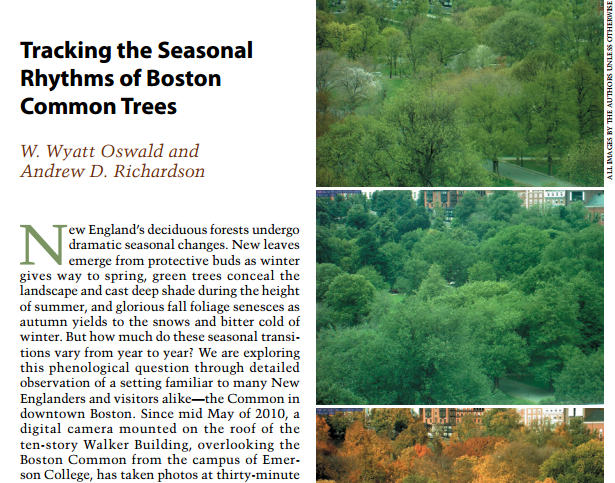
from sites all over the world, including this one from the
Boston Common, along with several sites at Harvard Forest
and some Schoolyard Ecology sites.

Protocols, Photos of Buds, Related Teacher
Resources
Resources

Lesson Plan for integrating timing of tree phenology with
other organisms in food web such as caterpillars and birds.

Sneak Preview of Budburst Activity
GLOBE program Lesson Plan for bringing branches inside to observe budburst in classroom prior to timing of buds opening outdoors in field site.
Involves sketching, observing, predicting...