Showing posts with label Professional Development for Teachers. Show all posts

Thursday, August 29, 2019

Welcome New Schoolyard Teachers!

Harvard Forest Summer Institute 2019


Our Changing Forests Project Coach, Fiona Jevon, led a new group of teachers in practicing field site setup and data collection


Teachers got a chance to try out measuring and marking out 10x10 meter study plots. 


Belchertown High School Teacher, Louise Levy, shared her experience leading the Our Changing Forests project with teachers trying out this project for the first time.

Harvard Forest Ecologist, David Orwig, provided background information indoors, and brought teachers out to see the impact the tiny Hemlock Woolly Adelgid is having on Hemlock trees, one of Massachusetts forests'  foundation  species. 


Woolly Bully and the Hemlock, Project Teachers explored a large forest stand of Hemlock trees that is in decline due to the Woolly Adelgid infestation that is impacting much of the eastern U.S. forests.


J.R. Briggs Elementary Teacher, Kate Bennett, shared her 15 years of Woolly Bully project experience with new Schoolyard Teachers.


Buds, Leaves and Global Warming Project Ecologist, John O'Keefe, showed long term trends of the timing of budburst and leaf drop, in order to help teachers understand how warming temperatures are impacting the length of the growing season.

 Dr. O'Keefe shared graphs of his 29 year study at Harvard Forest.


Teachers practiced labelling trees for field study that they will set up at their school sites.
Overlook Middle School Teacher, JoAnn Mossman, left and above, mentored teachers who will be starting this project in September.
  
Hanover High School (NH), Maryann Postans also helped mentor new teachers in the field above.


Harvard Forest Information Manager, Emery Boose, worked with a small group of experienced Schoolyard Eco. teachers to support management of Schoolyard Eco. data.


Survey Says....


Teachers said....

Not only do I feel that I thoroughly learned the protocol, but I also got some excellent suggestions for classroom implementation.

Ecological background knowledge for me is key. I learned a lot from Orwig and others.

This time I was focused on techniques and strategies to improve the process.

I did not know much about trees, I learned a lot!

My ecology background was rusty, and this workshop got me up to speed.

My educational focus has been earth science. I learned a lot about trees and the interaction between the atmosphere and biosphere. So much more to learn!

Outstanding job explaining the science and classroom application of the lessons.
Wonderfully flexible, finding time and space for me to upload my school's data. 

I'm confident that I can set up a plot. 

This has improved so much over the years! 

Today's itinerary seemed like it worked a lot better for getting in sharing between individuals/small groups 

This is the only time my students are outside during their school day.

The buds study relates to their noticing of everyday life

 doesn't last just one class period. I think the longevity of this study is eye-opening.

That the information is being reported to "real scientists" means that students more fully buy in

They (students)will actually be doing the practices (scientific practices as outlined in NGSS and Mass. Frameworks), rather than talking about them in class.

We will be able to set up study sites at Wildlands struts properties and engage students in environmental learning for years to come.

Emery helped me realize why some graphs have dots and why some have lines. John O'Keefe answered a lot of questions from red/black oak to why a graph of growing season might be varied. 

I  told teachers from other schools about this workshop but they were unable to attend because they had already started school. Maybe have the workshop a little earlier. 

I think the date of which the workshop is offered may be challenging for teachers to attend (more and more schools are starting earlier) but I understand why it needs to be where it is. 

I loved every minute of this training. I hope to work out the logistics to get it off the ground.

What did Teachers Value Most? 


How to identify a hemlock tree, how to implement the study in a more complete manner and practical suggestions from a teacher in the field for its implementation.

Learning about the big picture - interaction between the atmosphere and biosphere. Identifying trees and how they change over the course of the year. Adapting the program to support elementary students. (Thanks Joann!)

Having more confidence for downloading and graphing the data. It was helpful to have the lessons being done at Belchertown High School as a model for what I can do with my students at my site

Getting an opportunity to work with an ecologist and ask questions

Links to Ecologists' and Mentor Teacher presentations


  • Review of Day 2 of the Our Changing Forests Summer Institute


Thanks to Clarisse Hart for her excellent photo documentation of this workshop! 

Wednesday, October 5, 2016

Summer into Fall; Buds, Leaves and Global Warming Project Updates


Before going outside for further practice, teachers tried out their new field ecology resources to aid them in identifying samples of native tree branches.  Project Ecologist, John O'Keefe introduced the project protocol and related scientific concepts. Here teachers are beginning to identify and label the 6 study leaves on each branch, with help from Dr. O'Keefe and Mentor Teachers.


 Mentor Teachers, Louise Levy and Maryanne Rotelli shared some tricks of the trade that they have learned over several years of engaging their High School students in the Buds, Leaves, and Global Warming study.


 Here is some of what teachers said was valuable about the Summer Institute:


This was a great introduction to this study. It was made simple which truly adds to the likelihood of implementation and success.

This study will allow me to engage multiple levels of students at my school in this research.
How to use citizen science effectively in the classroom

Going through the protocol so that I know exactly what my students will be doing and what pitfalls they may encounter.

How to set up the project and advice from mentor teachers

The study of phenology and how students can document the relationship between biotic and abiotic factors (plant leaf drop & on with weather).

The experience of trying out the protocol from the student perspective

Tree ID and learning how quick and easy it can be to implement this into the classroom.

I think the facility was great and the mentor teachers were very helpful. Thank you for having them.

Moving into Fall.....


Students from New Hampshire, Vermont, Massachusetts, New York City, Connecticut, and Rhode Island have begun collecting data on leaf color change and drop at their schoolyards. 


 Students Students from Shore Country Day School in Beverly, Ma. measure leaf lengths for the first field visit only.


Students from Wahconah High School in Dalton Ma. up in the Berkshires (left)are monitoring their trees Teacher, April LesSage reported: The leaves are slowly changing.  We are just seeing some start this week.  


Brooklyn Technical High School Field Site in New York's Fort Greene Park


Students are out collecting data on leaves in the schoolyard of Wilson Middle School,Natick,Ma.

Views from Hollis-Brookline High School in New Hampshire (left),  and Williston Northampton School, Western Mass.( right).


Thanks  to teachers, Robin Koval ,April LeSage, Elisa Margarita, Jane Lucia, Kate Bennett,Maryanne Rotelli, Sheila Pogarian for sharing the photos above.

Foliage Images North to South  From the Phenocam Network


Bartlett Forest
White Mountains, New Hampshire
Phenocam Image
9-29-16


Harvard Forest, Petersham, MA  Phenocam 9-30-16

Austin Preparatory School, Reading, MA.   Phenocam Image


Academy Hill School
Springfield MA
Phenocam Image
9-30-16


Carey Institute
New York
Phenocam Image
9-29-16


The big question many of us are asking is:  


Will this summer's drought impact the timing and beauty of fall colors????

See the following video and article in Weather.com to get a look at what some experts are predicting:

https://weather.com/science/nature/news/new-england-drought-dry-fall-foliage

Related Links:


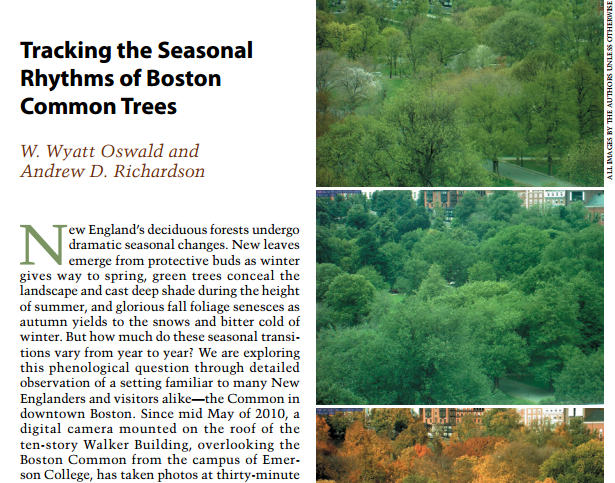
Tracking Seasonal Rhythms Article in Arnoldia
 by researchers, Wyatt Oswald and Andrew Richardson:  http://arnoldia Article.pdf


Buds, Leaves and Global Warming Schoolyard Ecology webpages: Buds-leaves-webpages-HF


Clickable Map of Buds and Leaves Field Sites:  map.fieldsites-HF


Tuesday, January 26, 2016

SAVE THE DATE- MARCH 31st-Spring Workshop


Harvard Forest Schoolyard Ecology Spring Workshop for Teachers  

MARCH 31, 2016 


Please schedule March 31st, 2016  for our Harvard Forest Schoolyard Ecology Spring Workshop for Teachers. 

Here's some basics on what to expect:   


TITLE OF COURSE: HARVARD FOREST SCHOOLYARD ECOLOGY SPRING WORKSHOP
 
Prerequisite:  Harvard Forest Summer Institute for Teachers

Professional Development Points (PDPs):  6 

Location, Date, Time:
HARVARD FOREST, PETERSHAM, MA;
March 31, 2016
8:30 A.M.-3:00 P.M.

Presenters:
JOHN O'KEEFE: Buds, Leaves, and Global Warming Project Ecologist
DAVID ORWIG: Woolly Bully and the Hemlock Trees Project  Ecologist
BETSY COLBURN:  Vernal Pools Project Ecologist
EMILY SILVER HUFF:  Our Changing Forests, Project Ecologist
5 SCHOOLYARD TEACHERS:  Presentations TBA-stay tuned for details.

Facilitator:
PAMELA SNOW, SCHOOLYARD COORDINATOR

Summary Description:
THE HARVARD FOREST offers a Schoolyard Ecology training workshop for teachers of grades 4-12 and environmental educators who have attended a summer institute and have collected fall data for the Forest Ecology Schoolyard studies.  Professional Forest Ecologists will prepare teachers to implement the spring field study protocols.  All teachers will participate in field walks with project ecologists.  Five experienced Schoolyard teachers will present related curriculum materials and student samples created throughout the school-year.

Goals:
  • To provide further background knowledge of project related themes and processes, in order to enable educators to implement the spring project protocols with students.
  • To encourage teacher networking and sharing of curriculum related to Schoolyard Ecology projects. 

Outcomes:
  • Teachers will be prepared to lead students in implementing spring field protocols. 
  • Teachers will be provided with peer developed curriculum insight, information, materials and/or student samples to aid in teaching project related themes.  

----------------------------------------------------------------------------------------------------------------------

Teacher Presenters Wanted:  

If you have developed some lesson plans, activities, or other educational resources that you would like to share with other Schoolyard teachers, we have 4 slots open for teacher presenters at our Spring Workshop on March 31st.  

Please contact Pamela Snow by email at:psnow@fas.harvard.edu for more information on what is involved in presenting.